Client question
Is the first product a heat-source module or a complete steam system?
A manufacturing route begins with system boundaries
A modular solar steam concept was assessed by separating collection, storage, heat exchange, steelwork, controls, and auxiliary systems before factory matching.
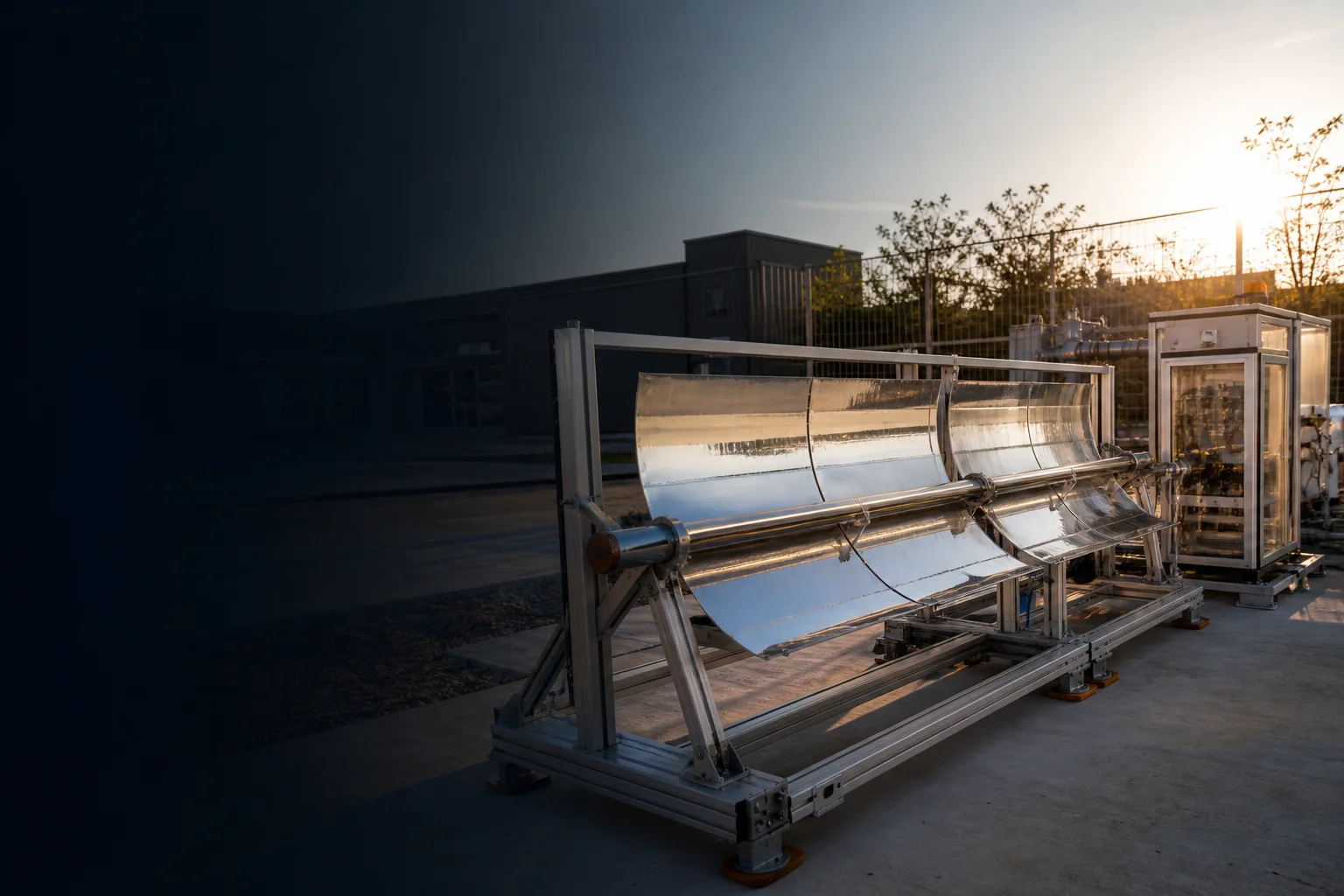
Is the first product a heat-source module or a complete steam system?
Is the first product a heat-source module or a complete steam system?
The first route should keep the heat-source module and wider system responsibilities explicit instead of hiding integration work inside a generic factory search.
Project Feasibility Assessment → module definition → pilot route
The public case is shown as a sequence of decisions and evidence gates—not as a promise of a supplier, quotation, or final project outcome.
Set the first credible product or operating scenario.
Make interfaces, dependencies, and responsibilities visible.
Surface technical, operating, compliance, and service conditions.
Turn the open questions into a bounded next-stage brief.
Illustrative public process. The exact sequence changes with the brief, available evidence, and approved scope.
The concept needed to be manufactured in China and assembled in a remote market, but the boundaries between a modular kit and a pressure-bearing system changed the engineering, safety, and service obligations.
We decomposed the product and supply chain, compared modular and integrated routes, and organized risk questions around temperature, materials, interfaces, installation, maintenance, water quality, and pilot evidence.
The first route should keep the heat-source module and wider system responsibilities explicit instead of hiding integration work inside a generic factory search.
Start with a bounded modular package and a controlled pilot, then decide whether the wider system layer is ready for expansion.
Planning-level feasibility analysis. It is not engineering certification, a supplier quotation, legal or IP advice, or a guaranteed production-cost assessment.
Share the decision, the evidence you already have, and the risk you need to reduce. We will help identify the right next step.